


European Travels
Paris February 20-23, 2020
Winter break weekend was scheduled for Sara to go with her school on a four day ski trip to the Pyrenees in northern Spain and Julie and I booked two nights in a resort in one of Spain's wine regions, Ribera del Duero. After Sara suffered a high altitude induced massive nose bleed at the Sierra Nevada ski resort over Christmas break those plans were scrapped and Paris was our back up journey.
Our hotel was located close to the d'Orsay museum directly on the Seine in the 6th arrondissement. On our first day we enjoyed a casual stroll to the under repair Notre Dame cathedral then up to the Louvre, through the tuileries gardens and then the Champs-Elysees to the Arc de Triomphe. We meet Madeline Fuhrman for dinner at my departed friend Len Zubrensky's favorite Parisian restaurant, Epi dupin(I have known Madeline since her birth as I am good friend's with her mother Elina). Madeline is a singer, songwriter and adventurer extraordinaire currently living in the city. We enjoyed three terrific dinners with her and her partner Rose and relied on their fluency with the language in ordering. Who knows what we would have ordered without them. And of course at Epi d'Dupin we toasted Len, "Let the hijinks begin".


Great restaurant and very fun evening!!


On day two we took an absolutely fabulous four course lunch river cruise on the Seine with Bateaux Parisiens. The company also offers a dinner cruise. With the benefit of hindsight I wish we had opted for the dinner cruise to see the Eiffel tower fully lite at night.


The next day I opted to take the Fat Tire 3 hour bike tour of the city. Among other interesting facts and observations, we learned that during World War II, Hitler only visited the city once and that for his visit he planned to go to the top of the Eiffel Tower and raise the Nazi flag personally. Thankfully members of the underground severed the elevator cables ahead of his visit so that he was not able to have his moment of triumph. Also as the war was coming to an end Hitler ordered that all of the historic buildings and monuments in Paris be blown up. Fortunately, the military governor of Paris, Von Choltitz, refused to carry out the order and surrendered to the Allies.
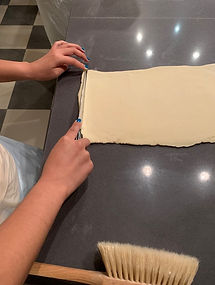
While I did the bike tour, Julie and Sara took a three hour croissant-making class. They made a ton of different types of similar croissant treats, said it was super fun, but that probably, if we eat croissants, we'll just buy them from the experts - they really have that process down. And it's quite a process.


On our last evening we enjoyed three cello/piano concertos at Theatre des Champs Elysees. Luckily even with the coronavirus causing cancellation of our trips to Amsterdam(3/4-8) and Italy(4/3-11 Milano, Lake Como, Verona, Venice and Rome), we will always have Paris!

Lisbon "Lisboa" December 6-9
December 6 is Constitution Day in Spain and is a holiday. The holidays and adjoining days are typically included to make it a four day weekend. So this year the holiday was four days Dec. 6- 9th and for good measure, Sara's school added a teacher workday on the 10th, so we took off to explore Lisbon, Portugal. We took an early morning flight Friday and flew in to Lisbon as the sun was rising. Arriving at our hotel, we were delighted to find it was located on Liberty Avenue a short half-mile walk to the city's main plaza which is located on the Tagus River. After several hours of exploring on foot, we hired a tuk-tuk to take us on an hour-long tour of the central city.
.jpg)
Tuk tuk vehicle. Slightly harrowing experience but we made it:-)

A significant date in the city's history is November 1, 1775. On that all saints day at 940 am the city was struck by an 8.5 magnitude earthquake which with the ensuing fires and tsunami almost completely destroyed the city. At that time the city's population was 250,000, and 50,000 people died in the quake. It was the first earthquake to be studied scientifically and led to the birth of seismology.
Shortly after the disaster, King Joseph I elected to completely rebuild the city with a plan that entailed constructing large squares, rectilinear, large avenues and widened streets. Although the wide streets at that time were considered wasteful, the King's decision was quite prescient in providing for the needs of a modern city.
On our tuk-tuk tour, among other things we were shown ruins of a Roman colosseum which were found during a construction project. The original is believed to have seated 4000 people. Lisbon is also home to the country's National Pantheon, a monument that is built in the baroque style in which the great men and women to whom the country owes its identity are laid to rest. Writers, singers, politicians and sports stars are among those honored. Politics play a role in the selection process. In 2010 Portugal's Nobel prize-winning author (literature), Jose Saramago died however he was denied the privilege of burial in the Pantheon because of his life long association with the country's communist party. Subsequently, a more left-leaning government came to power and has honored him with a park named in his honor close to the Fado Museum (see a Fado singer and band in the video below) and the Alfama district. Located directly across is a narrow street is a home to about nine restaurants that present the city's unique Faldo singers. We enjoyed both our meal and the music at Taverna del Rey. Enjoy the attached clip and do not miss it when you visit the city.

The main square in Lisbon - Christmas market was here.

National Pantheon
On day two of our visit, we took an all-day tour of important nearby destinations. First stop, Belem, located a short distance from the city center this area on the Tagus River is the location from which Portugal's sixteenth-century explorers embarked. Its seafaring past is commemorated with a Discoveries monument and the tower of Belem.
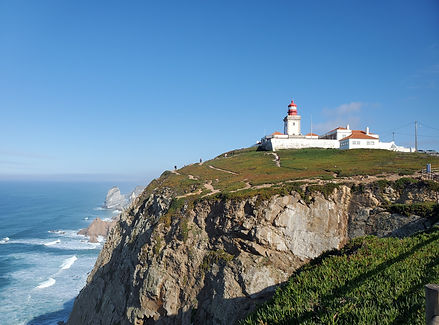
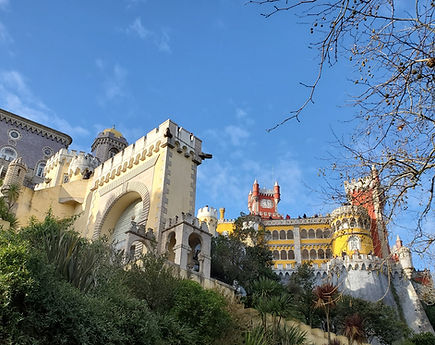
Next stop the city of Cascais, a coastal resort town known for its sandy beaches and marina. From there we ventured to Cabo da Roca, the westernmost point of the Sintar mountains with a spectacular view of the Atlantic. Next, we journeyed up the mountain to visit the Pena Palace, a truly magnificent complex that reflects its Muslim and royal past. The surrounding gardens are quite impressive. For our final stop, we visited the village of Sintra at the base of the mountain on which the palace sits. Although saturated with tourists our walk through the village was enjoyable. Here as in our other stops both in and outside of Lisbon as first-time tourists, we were offered shots of the indigenous liquor, ginjinha (a cherry based liquor we did not find particularly tasty).
.jpg)
.jpg)
Lisbon main city center plaza
.jpg)
.jpg)
Belem and the Tagus River
.jpg)
.jpg)
Experience the palace with us in the video below (expand the video in the bottom right corner when playing for better viewing)
Prague "Praga" November 28-December 1
We arrived in Prague on the afternoon of Thanksgiving to spend the holiday weekend with my high school friend Patty Goodson and her husband Ivan Karhan. Patty is a classical pianist and artist. Ivan owns and operates the "Rocking Horse Toy Store." They graciously hosted us and their home was a short walk from a metro stop from which it was easy to travel to the central city.
Prague is the capital of the Czech Republic and was the historic capital of Bohemia. It is located on the Vitava River. In addition to having been the capital of Bohemia it also was an imperial seat of the Holy Roman Empire. In 1806 it became part of the Habsburg Austrian empire. After World War I the kingdom was dissolved and Czechoslovakia was formed. World war II saw the Nazis take and control the country only to be followed by Soviet domination during the cold war.
At long last in 1990 the Velvet Revolution resulted in a return to democracy with Vaclav Havel serving as its first president from 1990 -2003.
In 1993 the Czech republic peacefully separated from Slovakia.

The Astronomical Clock - built in 1410 - it is an engineering feat. For information about it go to this link: https://interestingengineering.com/the-secrets-of-the-prague-astronomical-clock
Old Town Square where the Astronomical Clock (and the Christmas Market is located.

With Patty and Ivan at a local restaurant
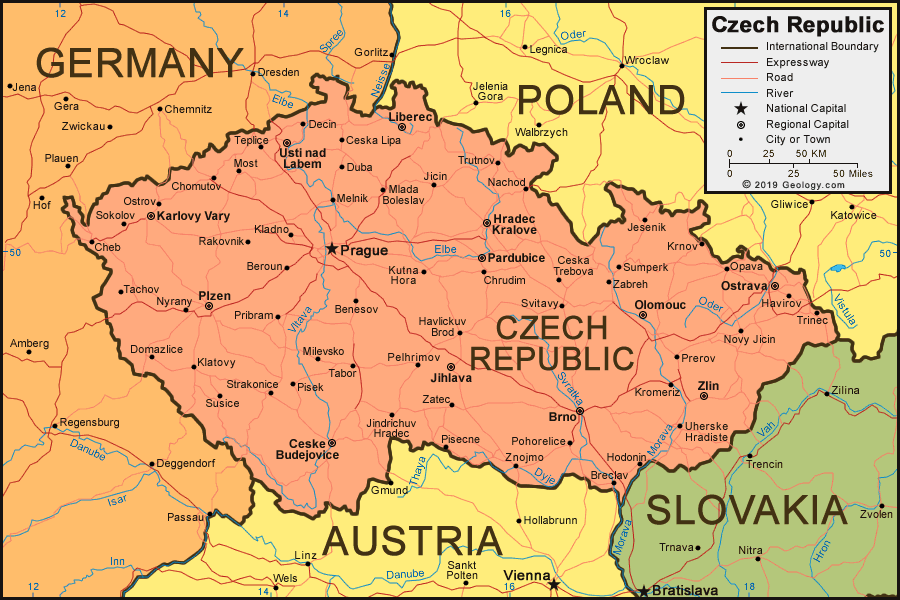
On our first full day in the city, we purchased a six-hour English city tour which consisted of three hours walking, an hour for lunch in a traditional Czech restaurant and a one hour boat cruise. We were the only ones that purchased the tour so it ended up being, in essence, a private tour.
We met in the Old Town Square beneath the Astronomical Clock. In front of the Old Town Hall, there is a memorial to twenty-seven martyrs that were beheaded on the spot in 1621 by the Habsburgs with twenty-seven crosses in the pavement. The victims all were supporters of the protestant uprising against the Catholic Habsburgs. Today only about ten percent of Czech citizens consider themselves Catholic.
The Astronomical Clock was first installed in 1410 and was only the third of its kind in the world. Today it is the oldest of its kind still in operation. The clock has undergone numerous repairs through the ages including for damage suffered in 1945 as the Nazis sought to suppress an uprising against their rule.

Prague straddles the Vitava River and is connected by numerous bridges, the most important of which is the Charles Bridge. Named for King Charles IV, the first stone was laid by the King on 9 July 1357 at 5:31 am, (a palindrome, 135797531, which Medieval beliefs attributed a magical power to odd numbers, so it was planned to be done on this date, at this time, for the palindrome magic) selected based on numerology to imbue the bridge with additional strength. The bridge is protected by three guard towers and includes thirty statues, mostly baroque.


Charles Bridge - almost 700 years old - amazing! King Charles laid the first foundational stone on July 9, 1357 at 5:31 a.m. for good luck. The date and time numbers are a palindrome which was considered magical in those times: 135795731


Most interesting was the Church of Our Lady Victorious and the Infant Jesus of Prague. The wooden statue of the baby Jesus dates to the 16th century. It is believed that the statute was created in Spain and was brought to Bohemia in 1556 where it was placed in the Church and cared for by Carmelite nuns.
The clothes of the infant are changed by the sisters from over 100 costumes to reflect the church calendar.


The baby Jesus doll donated by Spain and to this day is a major attraction for Catholics!
Three of hundreds of different dresses for the baby Jesus doll donated by nations around the world (!?).
Prague has the oldest active synagogue in Europe, Altneuschul located in the city's Jewish quarter. It was completed in 1270 in a gothic style.
Munchen Oct 31- Nov1

Old town hall - Altes Rathaus - Munich

New City Hall in Munich - in Marienplatz

National Socialism Documentation Center - A museum that documents the rise of the Nazi Party starting in 1919. Museum was created in 2015.
Old town hall - Altes Rathaus - Munich
During this year living in Madrid we plan to see as much of Europe as we can, given Sara's school schedule and our local activities. November first was a holiday, All Saints Day, so we chose this weekend for our first out-of-country journey. And it was off to Munich, the capital and most populous city in Bavaria. It is Germany's third-largest city.
Bavaria was established as a sovereign kingdom in 1806 and became a European center for arts, architecture, culture, and science. Today Munich is home to many multinational companies with its economy thriving with high tech, automobiles, IT, biotech, engineering, and electronics together with many others. The monarch King Ludwig III that ruled Bavaria was forced to abdicate during the German revolution in 1918 following the first world war. A short-lived Soviet republic followed. The military intervened and a republican government was restored. In that environment, Hitler and the Nazi party rose to power. Munich was considered the Capital of the Movement. Hitler first attempted to overthrow the republic in 1923 in the Beer Hall Putsch. After the Nazis came to power in 1933 the party created its first concentration camp, Dachau, there. During World War II more than 50% of the entire city and 90% of the historic center were destroyed by Allied bombing. Unlike mayors of other German cities, the leadership in Munich decided to restore most of its traditional cityscape, so we are able to see what it looked like for the most part prior to the war. In 1972 it hosted the Summer Olympics.
Despite a rainy weekend with high temperatures only reaching the mid 40s, we enjoyed our stay in this beautiful city. We took a bus tour to make sure we were aware of all of the city's significant landmarks. Among the highlights, is the city's central square, Marienplatz which was a short walk from our hotel. The square is home to an old and new city hall and features a glockenspiel which activates at 11 and 12 am every day (see videos). The old city hall, Altes Rathaus (see picture above) was constructed between 1392 and 1394. The former Talburg Gate of the first city wall serves as the spire. The grand hall was where on November 9, 1938 Joseph Goebbels gave a speech that was considered the prelude to Kristallnacht (an infamous night where Jewish shops and stores were destroyed all over Germany).
The new town hall was opened in 1874 and hosts the city's government. In its clock tower is the glockenspiel which dates to 1908. It consists of 43 bells and 32 life-size figures. The top half tells the story of the marriage of Duke Wilhelm V, founder of the Hofbrauhaus, to Renata of Lorraine. In honor of the wedding, there is a joust between a Bavarian(blue) and Lothringen(red) knight. Unlike our sausage races at Miller Park, the Bavarian knight always wins. Following the joust below there is a coopers' dance. The coopers were fiercely loyal to the duke and their dance symbolizes perseverance and loyalty to authority in difficult times. We made seeing this a priority and it is of note and generational significance that Sara's comment post-performance was "is that all there is?" It appears that a hundred and twenty-year-old glockenspiel does not easily translate for the digital generation. Also in the square was a Vegan Christmas market.
Following our visit to Marienplatz, we explored the English Garden. It is a large public park in the center of Munich created in 1789. Of course, no trip to Munich is complete without a visit to the Hofbrauhaus so with Sara in tow we enjoyed a cold brew and german food. I had a pumpkin soup that was quite special. To end our day we visited the museum NS-Dokumentationszentrum which is devoted to the history and role of the Nazi party in Munich. It is located at the site where the Nazi party headquarters was located. The museum opened in 2015 and traces the trajectory of the Nazi party from its founding 1919 to the country's efforts following world war II to recover and eradicate the regimes' evil. The exhibit presents Munich as the launchpad for the movement and explores how the city's art and festivals were harnessed to make the Nazi's seem kinder and gentler than they were and to document the complicity of the business community.
Munich was a principal center for armament manufacturing and industrial Germany and the middle and upper class were all more than willing to turn a blind eye to the darker side of Hitler and the party in exchange for the economic prosperity to make Germany great again, which Hitler ensured.